


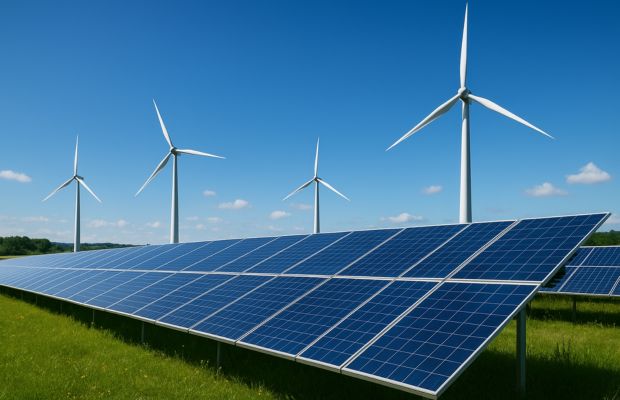
ACWA Power, Badeel and SAPCO, a subsidiary of Aramco, secure $8.2 billion financing to develop 15 GW of renewable energy projects in Saudi Arabia, accelerating the kingdom’s clean power expansion. The companies expect the projects to be operational in the second half of 2027 and the first half of 2028, helping Saudi Arabia advance its clean energy ambitions under its national renewables program.
While ACWA Power is the world’s largest private water desalination company and a leading player in the energy transition and green hydrogen, Badeel is a wholly owned subsidiary of PIF, and Saudi Aramco Power Company (SAPCO) is a subsidiary of Aramco, a state-owned integrated energy and chemicals company based in Saudi Arabia.
Jointly owned by ACWA Power, Badeel , and SAPCO
The Saudi Power Procurement Company is the procurer and off-taker for the projects, which includes five solar photovoltaic plants and two wind farms, expected to deliver a combined capacity of 15 (GW).
- Solar PV plants
- Bisha – 3 GW, Asir Province
- Humaiji – 3 GW, Madinah Province
- Khulis – 2 GW, Makkah Province
- Afif1 – 2 GW, Riyadh Province
- Afif2 – 2 GW, Riyadh Province
- Wind Energy
- Starah – 2 GW, Riyadh Province
- Shaqra – 1 GW, Riyadh Province
The 7 projects are key components in Saudi Arabia’s NREP (National Renewable Energy Program)
The CEO of ACWA Power, Marco Arcelli says, “…With this milestone, we are accelerating towards bringing these giga-scale projects to life, which directly contribute to energy security in the Kingdom. Beyond lower-carbon power generation, these projects will potentially create thousands of jobs, stimulate domestic supply chains, and enable significant technology transfer to Saudi talent through dedicated training programs. As the largest agreement under the NREP, this landmark collaboration underscores the nation’s steadfast commitment to building a more resilient and sustainable energy landscape.”
The financing milestone reinforces Saudi Arabia’s long-term plans for energy diversification, supports the growth of domestic green-energy supply chains, and paves the way for significant job creation and technology transfer within the kingdom.
