


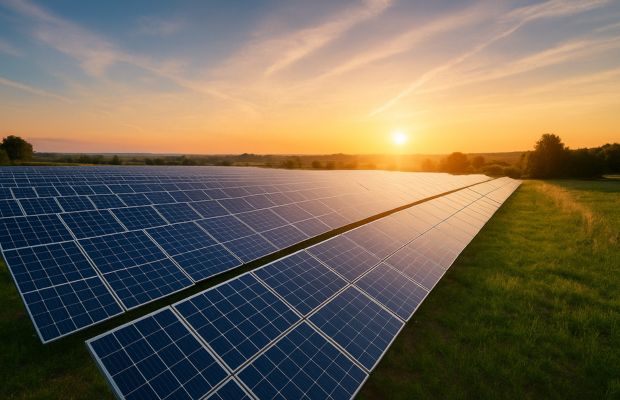
The Egyptian Cabinet Presidency recently announced the signing of a 30-year renewable energy purchase agreement by Renaissance Industries. The Cabinet said in a social media post that, under the agreement, Ersk will establish and operate a solar power plant to supply the Renaissance Cement factory with clean energy.
Under the agreement, Al Nahda Cement Company will purchase electricity generated from renewable sources under a 30-year Public-Private Partnership (PPP) arrangement with Cobalt, a subsidiary of the Ersk Group. As per the contract terms, Cobalt will conduct technical studies, secure financing, and construct and operate a 27 MW solar power plant to supply Al Nahda Cement Company with renewable electricity at competitive prices.
About the Project
In line with the state’s direction towards promoting the green economy and expanding the use of clean energy, and in accordance with the Ministry of Public Business Sector’s strategy to achieve sustainability and increase reliance on renewable energy sources, Engineer Mohamed Sheimy, Minister of Public Business Sector, witnessed the signing ceremony of the Power Purchase Agreement (PPA).
The agreement was signed between Al Nahda Industries Company (Al Nahda Cement Factory in Qena)—a leading cement producer in Upper Egypt and one of the companies under the Holding Company for Chemical Industries—and Cobalt Company for Electricity Sales and Distribution, which is affiliated with Ersk Company for Renewable Energy Solutions. The ceremony took place at the Ministry’s headquarters in the New Administrative Capital.
The agreement was signed on behalf of Al Nahda Industries by Engineer Magdy Tawfik, Chairman and Managing Director, and on behalf of Cobalt by Engineer Andrew Daniel, Chairman and Managing Director.
Goal of The Agreement
Cobalt will also manage and execute all phases of the project, including financing, engineering, procurement, construction, operation, and maintenance throughout the contract period, while adhering to the highest occupational health and safety standards and environmental regulations.
In this context, Engineer Mohamed Sheimy affirmed that the agreement falls within the framework of the Ministry’s strategy to promote the green transition and increase reliance on renewable energy sources and energy efficiency across affiliated companies, in support of sustainable development. He explained that the agreement supports Al Nahda Company’s efforts to reduce carbon emissions and promote sustainability practices, noting that reliance on renewable energy enhances company competitiveness and demonstrates commitment to environmental responsibility.
He added that the agreement is consistent with the requirements of the European Carbon Border Adjustment Mechanism (CBAM), which contributes to strengthening the company’s presence in global markets, particularly the European Union.
For his part, Engineer Magdy Tawfik said that the agreement will help achieve long-term stability in energy costs, thereby enhancing the company’s competitiveness, while also supporting its commitment to environmental responsibility and reducing carbon emissions associated with its operations.
Engineer Andrew Daniel stressed that the agreement represents an important step toward strengthening the role of renewable energy in the industrial sector, noting that the partnership with Renaissance Industries will help reduce operating costs and support the transition to a low-carbon green economy.
