


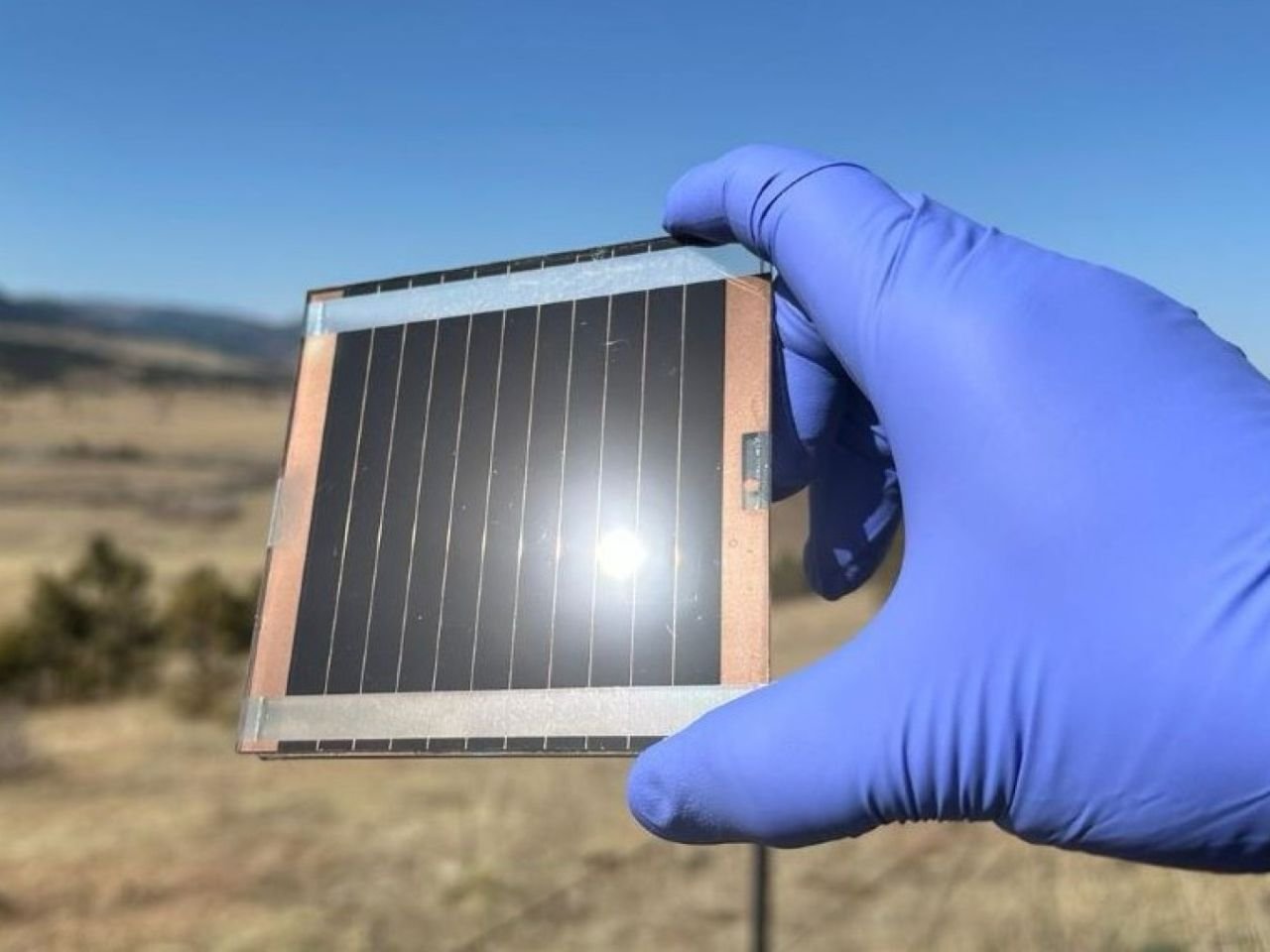
A new scientific study at Rice University, Houston, Texas, has reported a major advancement in solar technology, focusing on perovskite-based solar cells, a material that is increasingly seen as a strong alternative to traditional silicon.
The research demonstrates a method to make these solar cells more stable and durable, addressing one of the biggest challenges that has limited their large-scale use.
What Makes Perovskites Important?
Perovskites are materials that can absorb sunlight very efficiently. They are easier and cheaper to manufacture compared to silicon, as they can be processed in liquid form or deposited as a thin film.
However, their biggest drawback has been poor stability. Over time, these materials tend to degrade, losing efficiency and turning from a useful “black phase” into an ineffective “yellow phase.”
As one of the researchers explained, “We call this the black phase of crystallisation, and it is the only one that is useful as a solar cell.”
Key Innovation: Two Additives
The researchers developed a solution by adding two specific materials during the manufacturing process:
-
A two-dimensional perovskite, which helps guide the crystal structure
-
Formamidinium chloride, a chemical that improves stability and bonding
Together, these additives help the material form the desired black phase more easily and prevent it from degrading quickly.
The improved solar films showed impressive durability. They retained 98 percent of their original efficiency even after 1,200 hours of testing at high temperatures.
This is a significant improvement, especially since heat and light exposure are the main causes of degradation in solar materials.
Understanding the Science in Simple Terms
For solar cells to work well, their internal structure must allow electrons to move freely. In perovskites, this depends on how atoms are arranged inside the material.
If the structure is perfect, the material absorbs almost all sunlight, appearing black. If the structure shifts, it reflects light and turns yellow, reducing performance.
The new method ensures that the structure stays stable, even under stress.
Another key finding was how the additives change the way the material breaks down over time.
Instead of following the usual easy degradation path, the modified material is forced into a more energy-intensive degradation route, slowing the process significantly.
As one researcher noted, “Unlike the conventional degradation pathway via the yellow phase, this co-additive approach completely bypasses it and introduces an alternative, energetically uphill route.”
Better Crystal Quality and Protection
The additives also improve the size and alignment of crystals within the material. Larger and well-aligned crystals reduce weak points where damage can begin.
This makes the solar cells more resistant to moisture, heat, and light exposure – factors which generally are responsible for the degradation.
Why This Matters for the Solar Industry
Currently, silicon solar panels operate at around 22–23 percent efficiency, while advanced designs combining silicon and perovskites can reach 30–35 percent efficiency. This breakthrough could make perovskite technology more reliable, helping it move closer to commercial use.
Apart from generating electricity, solar technologies like these can also be used to power chemical reactions, such as producing hydrogen fuel.
The research also introduced improved testing methods, allowing scientists to study up to 100 solar devices at once, leading to more reliable results.
By solving the stability issue, researchers are bringing perovskite solar technology closer to real-world deployment, potentially transforming how solar energy is produced in the future.
