


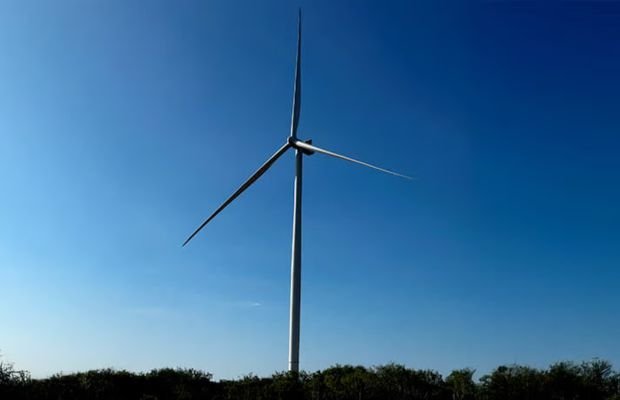
The Asian Development Bank (ADB) has signed a $116 million financing package with Acwa to support the development, construction, operation, and transfer of a 300-megawatt (MW) wind power plant. The plant is located in Uzbekistan’s Bukhara region, further accelerating the country’s transition to renewable energy.
In a press release, ADB has financed several of Acwa’s renewable energy projects in Uzbekistan, including the 500-MW Bash and 500-MW Dzhankeldy wind power projects, the 200-MW Nukus 2 Wind and Battery Energy Storage Project, and the Samarkand 1 and 2 Solar PV and BESS Projects.
The financing comprises loans of $50 million from ADB’s ordinary capital resources; $41 million mobilized from commercial lenders, with ADB acting as mandated lead arranger and bookrunner; and $25 million from the Leading Asia’s Private Infrastructure Fund 2 (LEAP 2). ADB also serves as environmental and social coordinator for the Asian Infrastructure Investment Bank (AIIB) and Standard Chartered, which are parallel lenders.
LEAP 2 is an ADB-managed fund with a $1.5 billion commitment from the Japan International Cooperation Agency. Established in 2023, it focuses on sustainable private sector infrastructure projects that reduce carbon emissions, improve energy efficiency, and provide affordable health care, education, and communication services to ADB’s developing member countries.
The power plant—known as Bash 2—is an extension of the Bash Wind Power Project, which was cofinanced by ADB in 2023. Bash 2 will feature 39 wind turbine generators, each with a nameplate capacity of up to 8 MW; a new 35/500 kilovolt substation; and approximately 1.5 kilometers of overhead transmission line to connect the plant to the national grid.
About The Project
“ADB’s connected approach is helping countries build resilience across energy, food, water, ecosystems, and communities in Uzbekistan,” said ADB’s Private Sector Operations Department Director General Isabel Chatterton. “The Bash 2 Wind Power Project expands Uzbekistan’s clean energy capacity, supports grid stability, reduces carbon emissions, and creates quality jobs. Alongside other ADB‑financed wind projects in Uzbekistan, this lifts ADB‑supported capacity beyond 2 gigawatts—demonstrating how long‑term partnerships translate climate ambition into resilience at scale while catalyzing private investment.”
The project will support local economic development by generating employment opportunities, while fostering greater inclusion of women and girls in the renewable energy workforce. At least 800 jobs are expected to be created during construction and at least 25 permanent operational jobs. Additionally, the project will incorporate awareness-raising measures to support safe, inclusive, and well-managed project implementation, including technical study tours on wind energy farms for female students or graduates.
“Bash 2 represents a meaningful step forward in Acwa’s expanding partnership with Uzbekistan and the delivery of its energy transition ambitions,” said Acwa Chief Financial Officer Abdulhameed AlMuhaidib. “As we expand our portfolio in the country, it underscores the strength of well-structured public–private partnerships in mobilizing capital efficiently and delivering reliable, cost-competitive, and clean power at scale. We’re committed to deliver more for Uzbekistan to support achieving its power mix targets by 2030.”
