


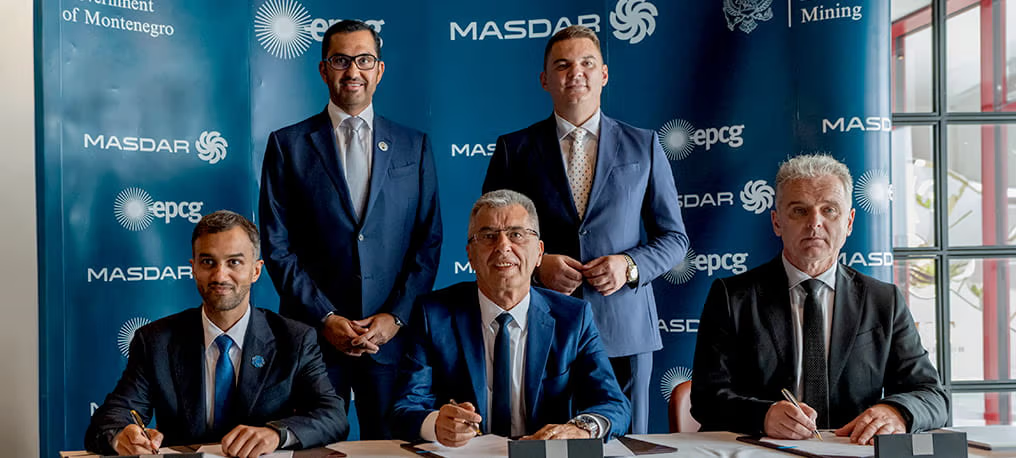
Abu Dhabi Future Energy Company PJSC (Masdar), a global clean energy leader, and Elektroprivreda Crne Gore (EPCG), Montenegro’s national power utility, have entered into an agreement to develop 150 megawatts (MW) of solar capacity, with the potential to add more than 400 MW of pumped hydro energy storage.
In a press release, Masdar said the joint venture aims to develop up to 2 gigawatts (GW) of renewable energy capacity in Montenegro, creating a platform to meet growing domestic electricity demand, strengthen national energy security, and support future electricity exports to neighboring European markets.
First Projects in 2 GW Montenegro Pipeline
The agreements represent the first projects to be progressed through the 50:50 joint venture to be established by Masdar and EPCG following the signing of the Joint Venture Agreement (JVA) in April 2026. The Joint Development Agreements (JDAs) cover the Štedim Solar Photovoltaic (PV) Project (115 MW) and the Krupac Solar PV Project (35 MW). Masdar and EPCG also signed a Framework for Action (FFA) agreement to explore the joint development of more than 400 MW of pumped hydro energy storage projects.
By storing electricity when supply exceeds demand and releasing it when needed, pumped hydro energy storage could enable Montenegro to integrate more renewable power while improving the flexibility, stability, and resilience of its electricity system.
In the presence of Sultan Ahmed Al Jaber, UAE Minister of Industry and Advanced Technology and Chairman of Masdar, and His Excellency Admir Šahmanović, Montenegro’s Minister of Energy and Mining, the agreements were signed in Tivat, Montenegro, by Milutin Đukanović, Chairman of the Board of Directors of EPCG; Zdravko Dragaš, Chief Executive Officer of EPCG; and Husain Al Meer, Executive Director, Global Offshore Wind and UK Business, Masdar.
Masdar and EPCG announced in April that they were forming a 50:50 joint venture to develop large-scale renewable energy projects across a range of technologies, including solar, wind, hydropower, pumped hydro, battery energy storage, and hybrid energy solutions. The partnership aims to develop up to 2 GW of renewable energy capacity in Montenegro to support domestic energy demand while enabling the export of renewable electricity to the Western Balkans and Southern Europe by leveraging the country’s existing subsea electricity interconnection with Italy.
Supporting Montenegro’s Regional Energy Ambitions
The joint venture established by Masdar and EPCG will explore utility-scale projects across solar, wind, hydropower, pumped hydro, battery energy storage, and hybrid energy technologies.
The platform is intended to meet Montenegro’s growing domestic energy requirements while creating opportunities to export renewable electricity to the Western Balkans and Southern Europe. Montenegro’s existing subsea electricity interconnection with Italy provides a potential gateway to the wider European power market.
Masdar has been active in Montenegro since 2018 through its investment in the 72 MW Krnovo Wind Farm, the country’s largest operational wind project.
Europe Central to Masdar’s 100 GW by 2030 Target
Europe remains a key strategic market for Masdar as it works toward achieving a global renewable energy portfolio capacity of 100 GW by 2030. TERNA ENERGY, which Masdar acquired in 2025, is developing the 680 MW Amfilochia Pumped Hydro Project, one of the largest pumped hydro energy storage projects in Europe. The project provides relevant technical and development experience that can support the opportunities being explored in Montenegro.
Masdar has a diversified global portfolio of more than 65 GW, spanning both established and high-growth renewable energy markets and covering the full spectrum of renewable technologies, including solar, onshore wind, offshore wind, battery energy storage, and hybrid solutions. The company continues to expand its global platform through disciplined growth across priority markets, delivering reliable and affordable clean power to meet the world’s rapidly growing electricity demand.
